
Cato constructs a world where ordinary people become icons and inherited memories take on lives of their own.
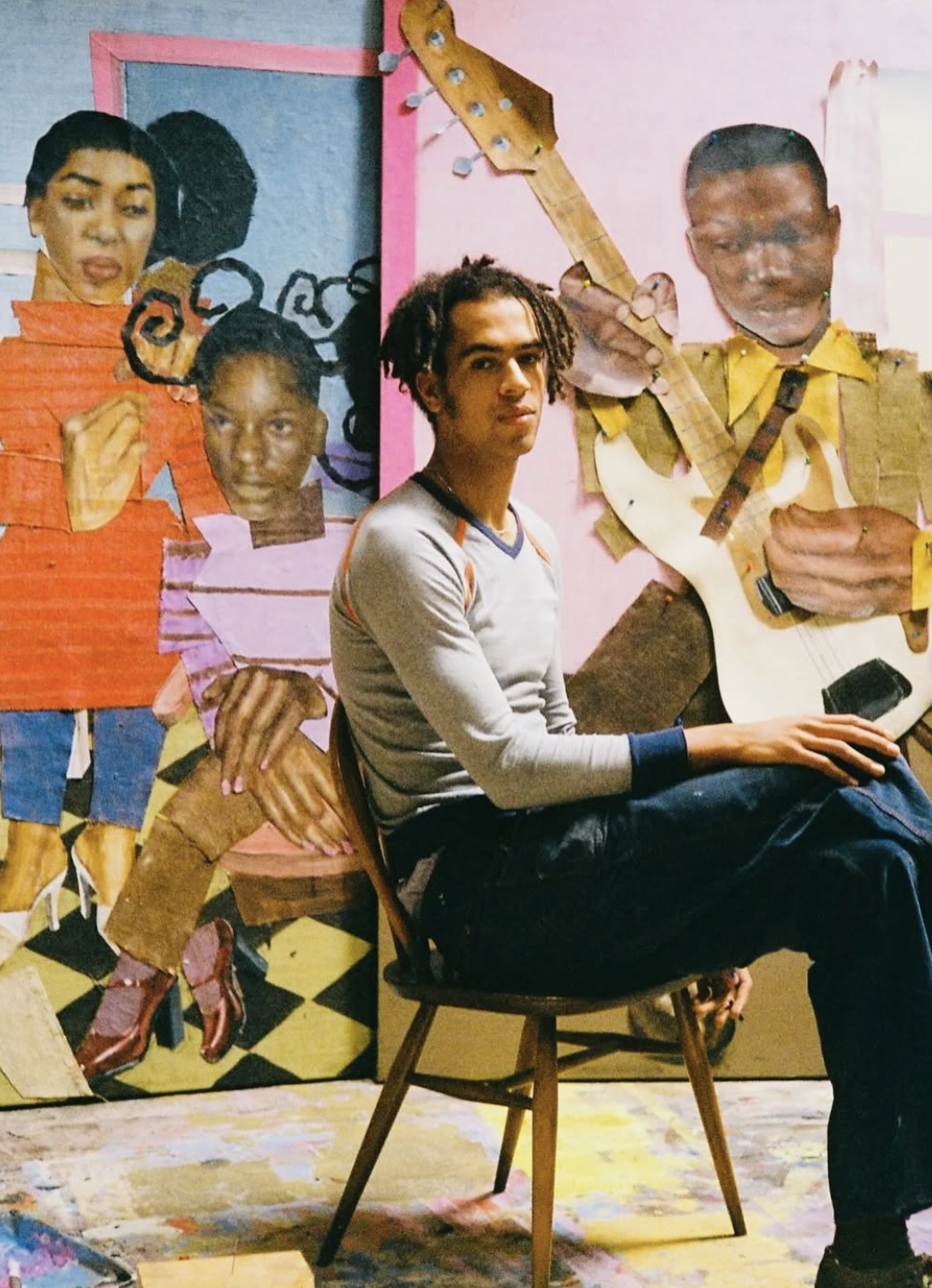
TOBY GRANT (CATO)
Before a Cato painting tells you where you are, it tells you who matters.
The face usually arrives first, oversized, meticulously rendered and charged with an expression that suggests the conversation started long before we entered the room. Then come the hands: holding a record, resting across a table, gripping an instrument or suspended in the middle of a gesture. Around them, the rest of the world is assembled through painted canvas, blocks of color, fragments of photography and visible seams.
Nothing is hidden, You can see where one material ends and another begins and Bodies appear to have been cut from one history and placed inside another. That act of assembly is at the heart of Cato’s work.
Born Toby Grant in Brighton in 1999 and now based in South London, Cato is a multidisciplinary artist and musician whose practice combines acrylic and oil painting, airbrush, collage, photography and painted fabric. He builds scenes from historical archives, family photographs, studio portraits, street encounters and images of Black cultural figures. The results sit somewhere between documentation and invention, familiar enough to feel remembered, yet surreal enough to belong entirely to him.
A barbershop, A domino game, Three musicians sharing a room, Men talking outside a place of work, Women gathered inside a hair salon, An older figure sitting quietly while life unfolds around him; These are not the grand events around which history is usually organized. Cato is interested in the moments between those events, the conversations, gestures, silences and rituals through which culture is actually lived.
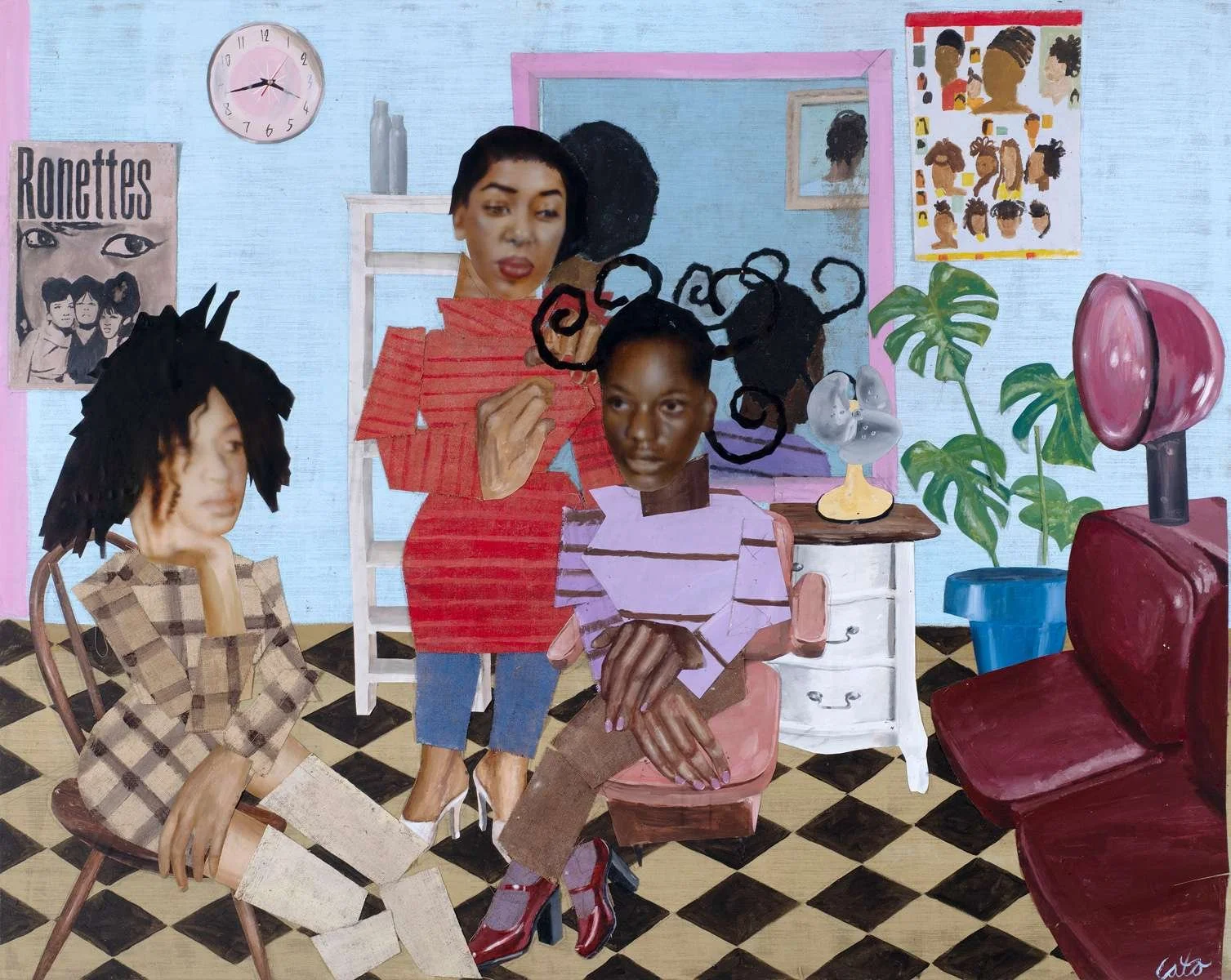
CATO | THE LOOP (2025)
An Inheritance Made From Fragments
Cato’s paternal grandparents were from Jamaica, while his father is a historian whose books became an early visual archive for the artist. Photographs of jazz musicians, boxers, political figures, street scenes and Black cultural life gave him access to people and places beyond the environment in which he was raised.
Growing up mixed-race in Brighton, his relationship with Blackness was not always simple or easily defined. His work reflects the tension of being connected to a culture while still searching for one’s place inside it. He has described his practice as a way of making sense of his “scattered interests and Blackness”, a process that allows him to question the idea that there is one fixed or universally shared Black experience.
That search for belonging appears throughout his paintings. Through his work, Cato can step into memories he did not personally experience but still recognizes as part of his cultural inheritance. He can place himself inside the barbershop, beside the boxing ring, at the domino table or among the musicians in one of his father’s books. Painting allows him to collapse the distance between what he remembers, what he inherited and what he wishes he had known.
His scenes feel nostalgic, but they are not confined to the past. They are new memories constructed from the material of old ones.
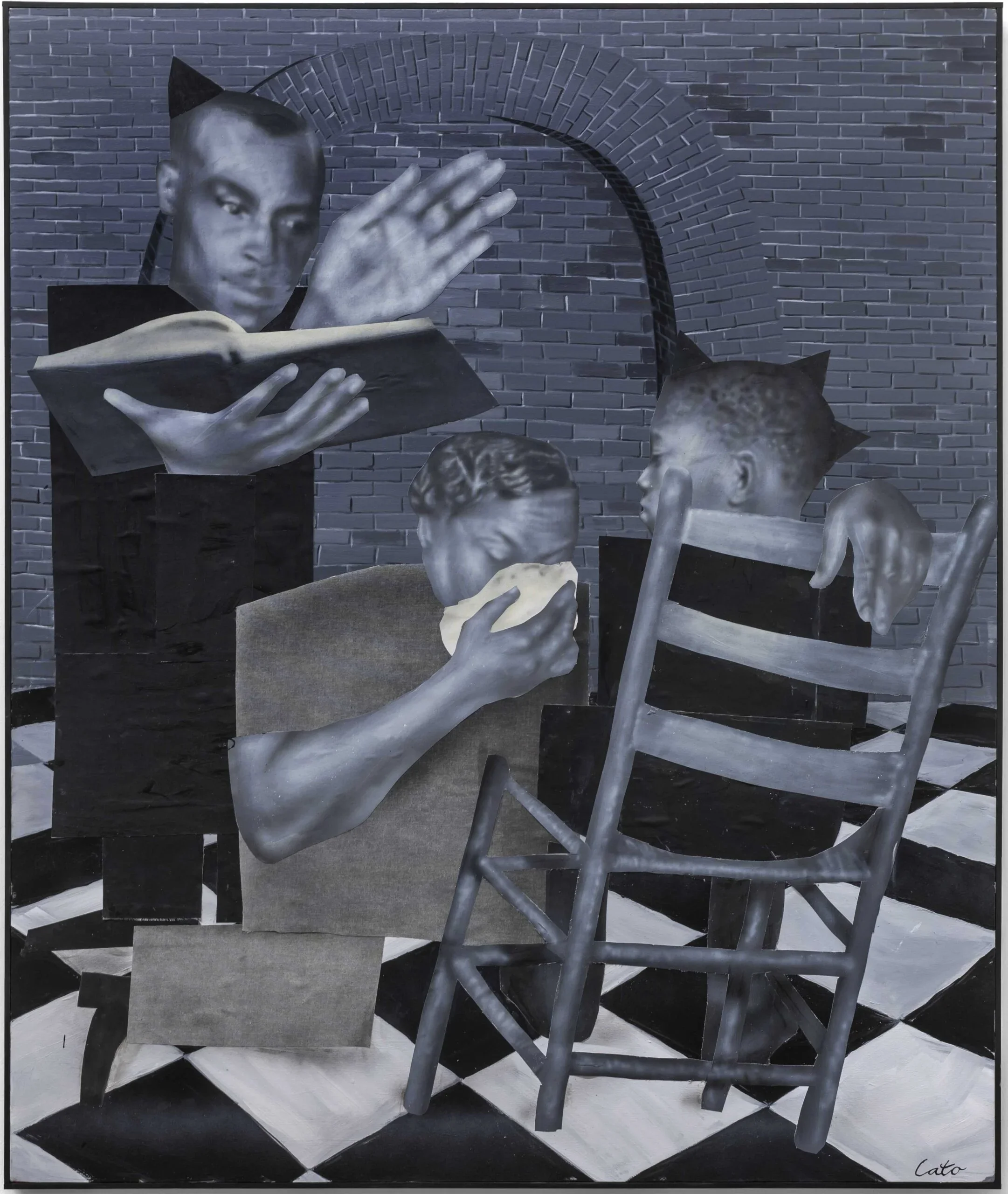
CATO | THE SERVICE
Building the Image
Cato’s process begins with people. For some of his more recent work, he has invited members of his South London community into his studio to be photographed. He also works with family photographs, archival material, Polaroids and images discovered in books. Once he finds a face, he begins to paint.
In much of his earlier work, Cato started with a black acrylic base before airbrushing white paint across it, gradually drawing out light, expression and detail. He began experimenting with airbrush while living and working in Mexico City, appreciating how quickly it could create light while retaining the feeling of vintage photography.
The completed heads and hands are cut from the canvas and collaged onto a larger surface. Cato moves these pieces around, testing their relationship to one another before constructing bodies and environments from geometric forms and additional pieces of painted canvas.
This freedom allows him to discover the scene instead of executing a completely predetermined composition. A figure can be shifted slightly forward. A hand can become larger. A head can lean toward another character. The emotional temperature of the painting changes with every movement. It is closer to directing than traditional composition.
Cato has described film as one of his favorite art forms, and its influence can be felt throughout his work. His paintings resemble frames taken from stories already in motion. We are not given a complete explanation of what happened before or what will happen next, but the placement of every character suggests that something exists beyond the canvas. Collage allows him to animate without a camera.
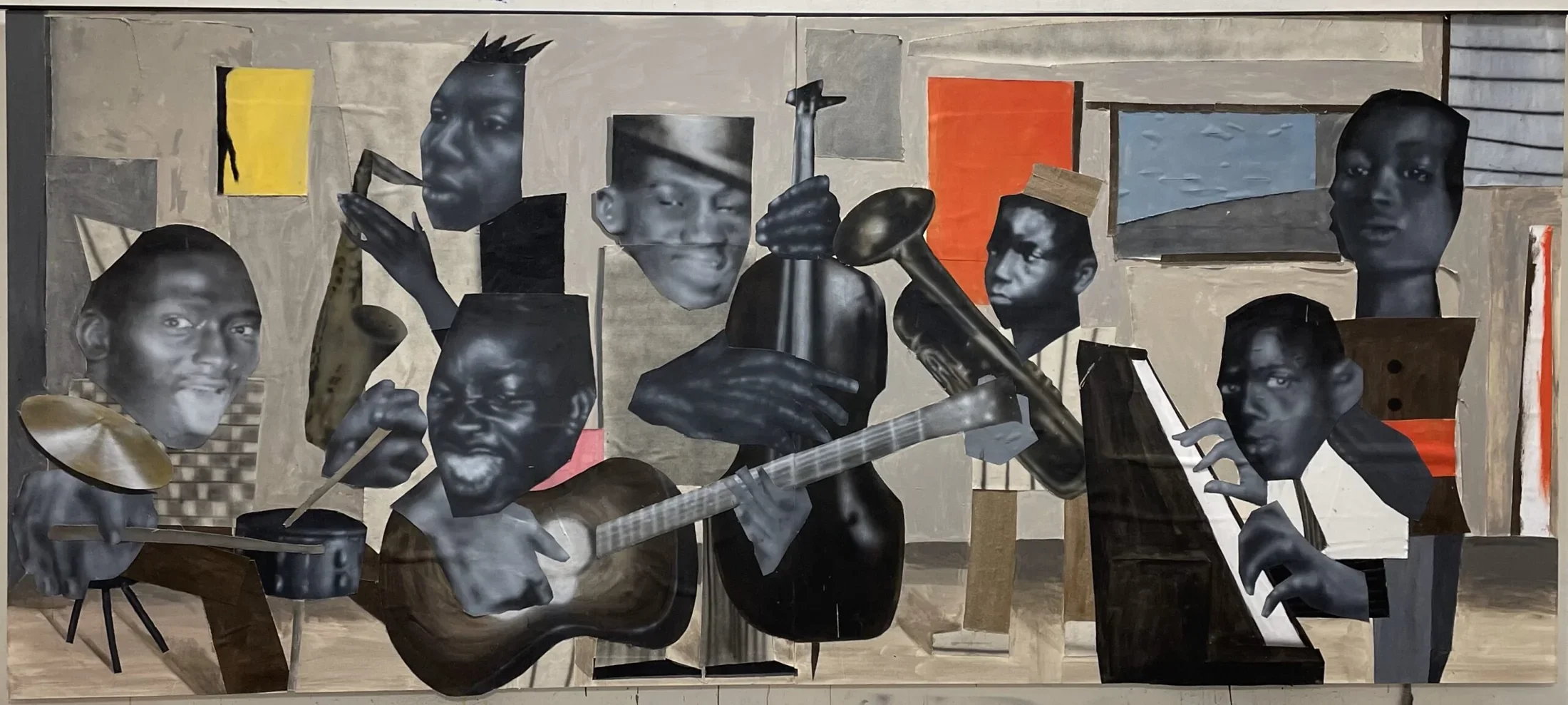
CATO | JAZZ
Talking to His Heroes
Cato’s visual language is distinctly his own, but he makes no attempt to disguise where it comes from. Romare Bearden can be felt in the fragmented bodies, layered histories and musical construction of his scenes. Kerry James Marshall is present in the commanding Blackness of his figures and in the decision to place Black people inside the visual scale of history painting. The photography of Malick Sidibé informs his attention to style, intimacy and cultural life, while the distortions of Cubism appear in his exaggerated anatomy and geometric environments.
Cato also draws from Picasso, Manet, Basquiat, jazz photography, street culture, cutout animation and the directness of low-budget flash photography. He treats style as a tool rather than a permanent identity, moving between airbrush, acrylic, oil, collage and animation whenever the work demands it.
In an art world where young artists are often encouraged to develop a recognizable visual product and repeat it, Cato resists being trapped by his own success. He understands that a signature can quickly become a limitation and This openness does not make his work less recognizable.
A Cato painting can be identified through the scale of its heads and hands, the contrast between detailed faces and loosely constructed bodies, the movement created by its visible joins and the emotional weight given to ordinary interactions. But within that framework, the work continues to change.
Cato is not merely borrowing from art history, He is entering into conversation with it. He takes techniques associated with the canon, dismantles them and rebuilds them around people who have too often existed at its edges.
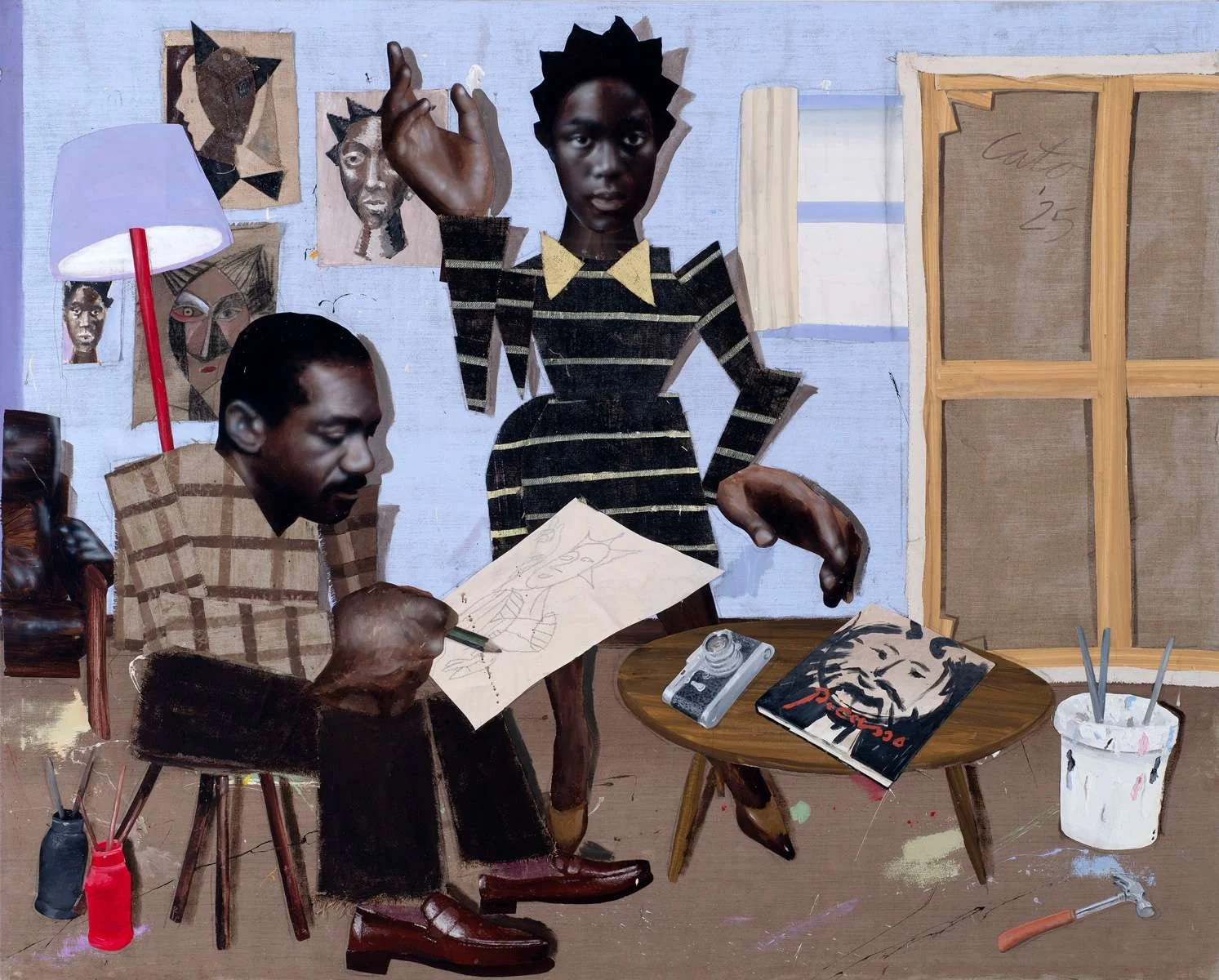
CATO | THE WORK - ROBBIN’ EM BLIND (2025)
The Monumental Everyday
The most radical aspect of Cato’s practice may be his choice of protagonist. His paintings frequently center Black elders and the “uncle-like” figures recognizable across the diaspora (the men who hold court at family gatherings, tell stories that grow more outrageous with each retelling, play music, debate politics and turn an ordinary afternoon into mythology.)
That fascination comes partly from listening to his father and uncles trade stories while he was growing up. Those conversations helped shape both his understanding of masculinity and his appreciation for the informal storytelling carried by Black elders.
Cato presents these figures without flattening them into symbols of wisdom, suffering or nostalgia. They are funny, stylish, contemplative, imperfect and fully alive. Their enlarged faces and hands command attention.
Cato has explained that facial expressions often drive the content of his paintings, while the oversized hands reflect how much people communicate through gesture. A passing expression becomes as important as the setting around it and A casual movement carries the visual weight of an historic event.
In museums and traditional history paintings, monumentality has often been reserved for royalty, military leaders, religious figures and the wealthy. Cato applies that scale and attention to people outside the official record. He treats “regular” working class people as subjects worthy of being remembered. This is where the iconic quality of his work truly exists.
It is not only that Cato has developed a recognizable aesthetic. He understands that an icon is created through attention. By painting these figures at such a commanding scale, he changes the terms under which they are seen.
His paintings function as an alternative archive built around presence. The way someone dresses.,The way an elder leans forward before beginning a story, The silence between a barber and his client, The particular intimacy of listening to music with another person, These details become evidence that a life was lived.
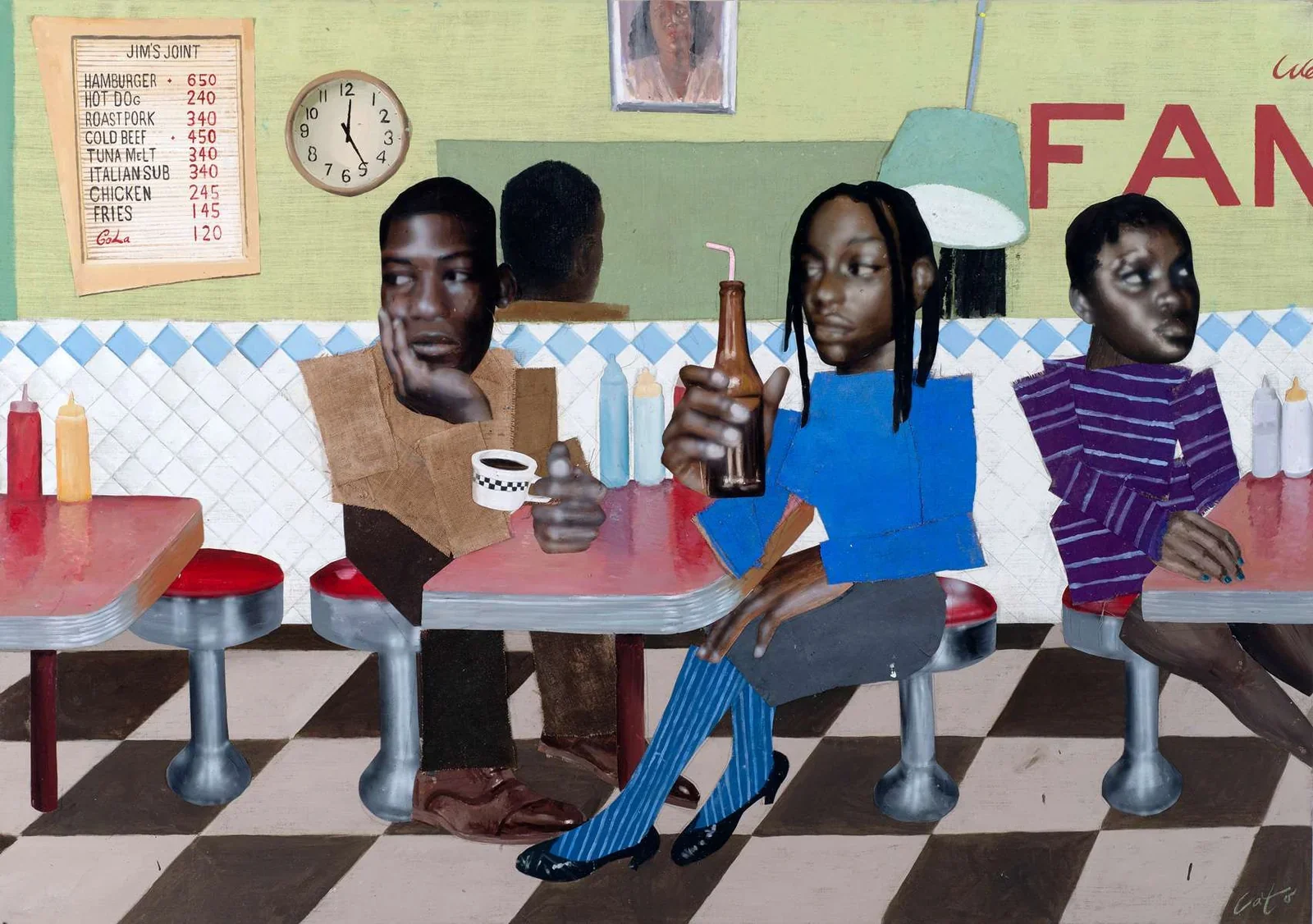
CATO | FAMOUS RAY’S (2025)
The Visible Seam
The cuts and joins in Cato’s paintings are essential. They remind us that every image—and every history—has been constructed.
Black diasporic identity rarely arrives as one uninterrupted story. It is passed between countries and generations through photographs, food, music, language, clothing, anecdotes and traditions whose origins may have become unclear. Some pieces remain intact, Others are missing. New pieces are created to hold everything together. Cato’s paintings take on a similar form.A photograph from the past meets a person from present-day Peckham.
The visible edges allow each fragment to retain part of its previous life. Rather than pretending that the image has always existed this way, Cato lets us witness its construction. The hand of the artist remains present in the cuts, irregularities, repositioning and changes of texture. That physicality gives the work its warmth. It feels made rather than manufactured.
For an artist interested in memory, this feels appropriate. Memory is never seamless either.
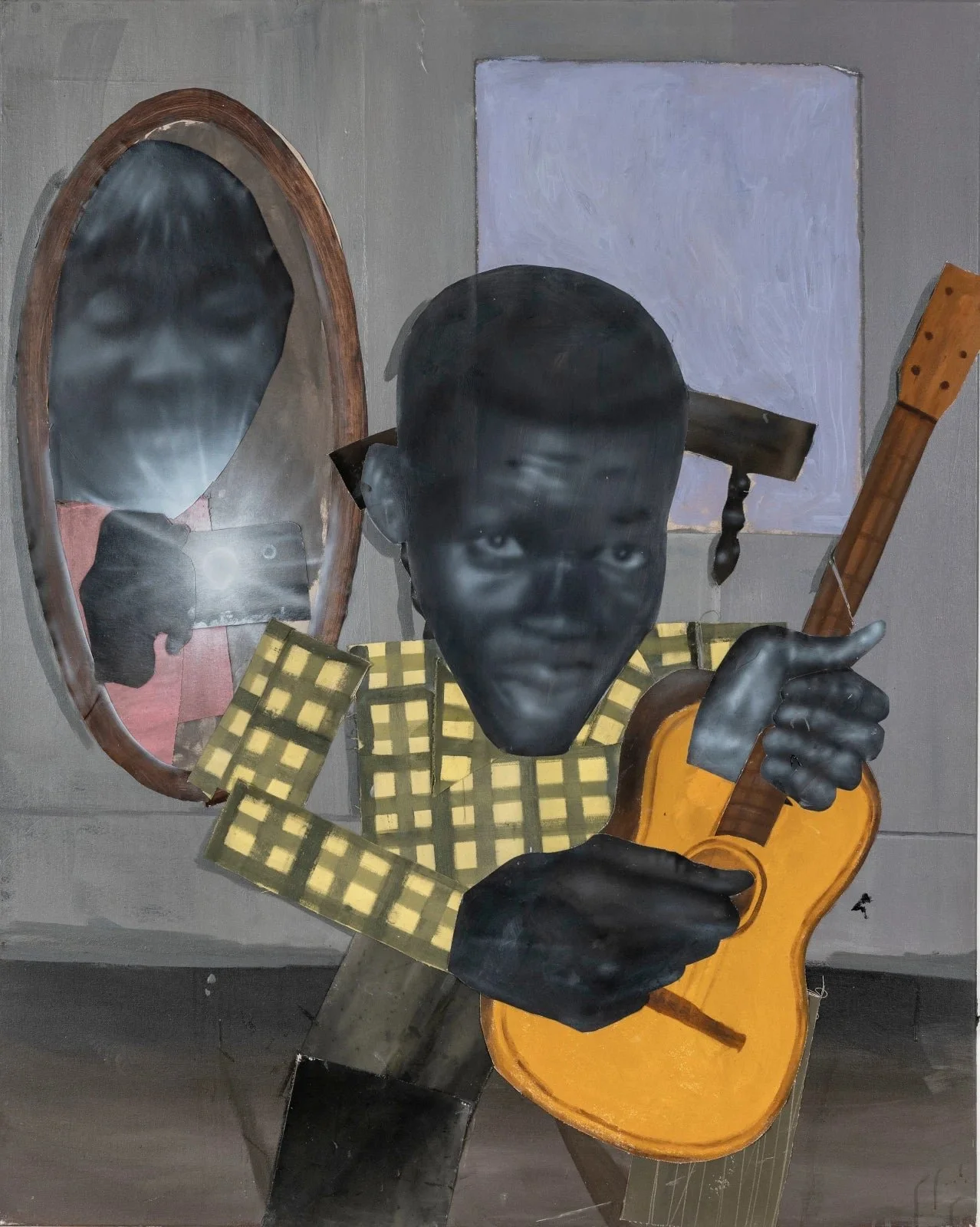
CATO | THE LOOK
Painting a World Into Existence
“I paint what I want to see,” Cato has said.
That statement could be understood as a desire for representation, but his work goes further than placing Black figures into spaces where they have historically been absent. He creates entire environments for them–rooms filled with music, conversation, art, food, fashion and the quiet rituals of community.
These are worlds in which Black people do not have to perform their importance because Their presence is enough.
As Cato continues to move between painting, music and animation, the characters inside his work appear increasingly capable of leaving the canvas, They already possess the elements of cinema.
Cato takes the fragments he has inherited and refuses to treat them as remains. He moves them around, paints over them, enlarges them and gives them new relationships. In doing so, he transforms the archive from a record of where Black life has been into a space where it can continue to imagine itself.
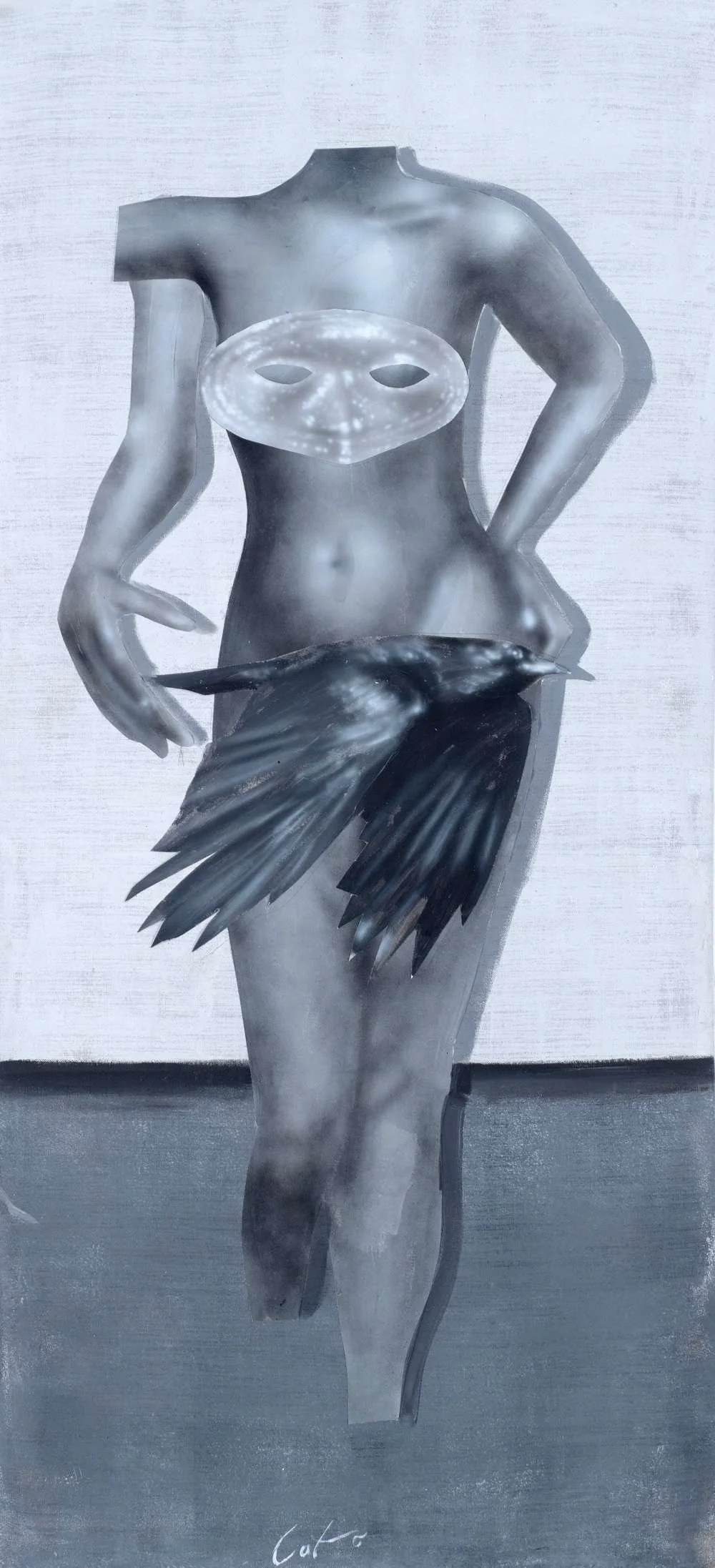
CATO | THE ENIGMA OF FACADE
Sources
Alayo Akinkugbe. Cato Ink’s Paintings Offer an Experimental Vision of Black British Life. Dazed, May 12, 2026.
Gwyneth Tambe-Green. Cato Paints Black Elders as Muses. Office Magazine, March 12, 2024.
Yaya Clarke. Cato.ink: Pairing Painting and Collage to Explore Belonging and Black Culture. WePresent, March 7, 2023.
Eric Firestone Gallery. Cato: Love Song. May 1–June 29, 2024.
Saatchi Yates. Cato. November 13, 2025–January 14, 2026.
Cooke Latham Gallery. Cato: Seen!. March 7–28, 2024.
Artist: Cato
Name: Toby Grant
Based: South London, England
Website: catoink.art
Instagram: @cato.ink